
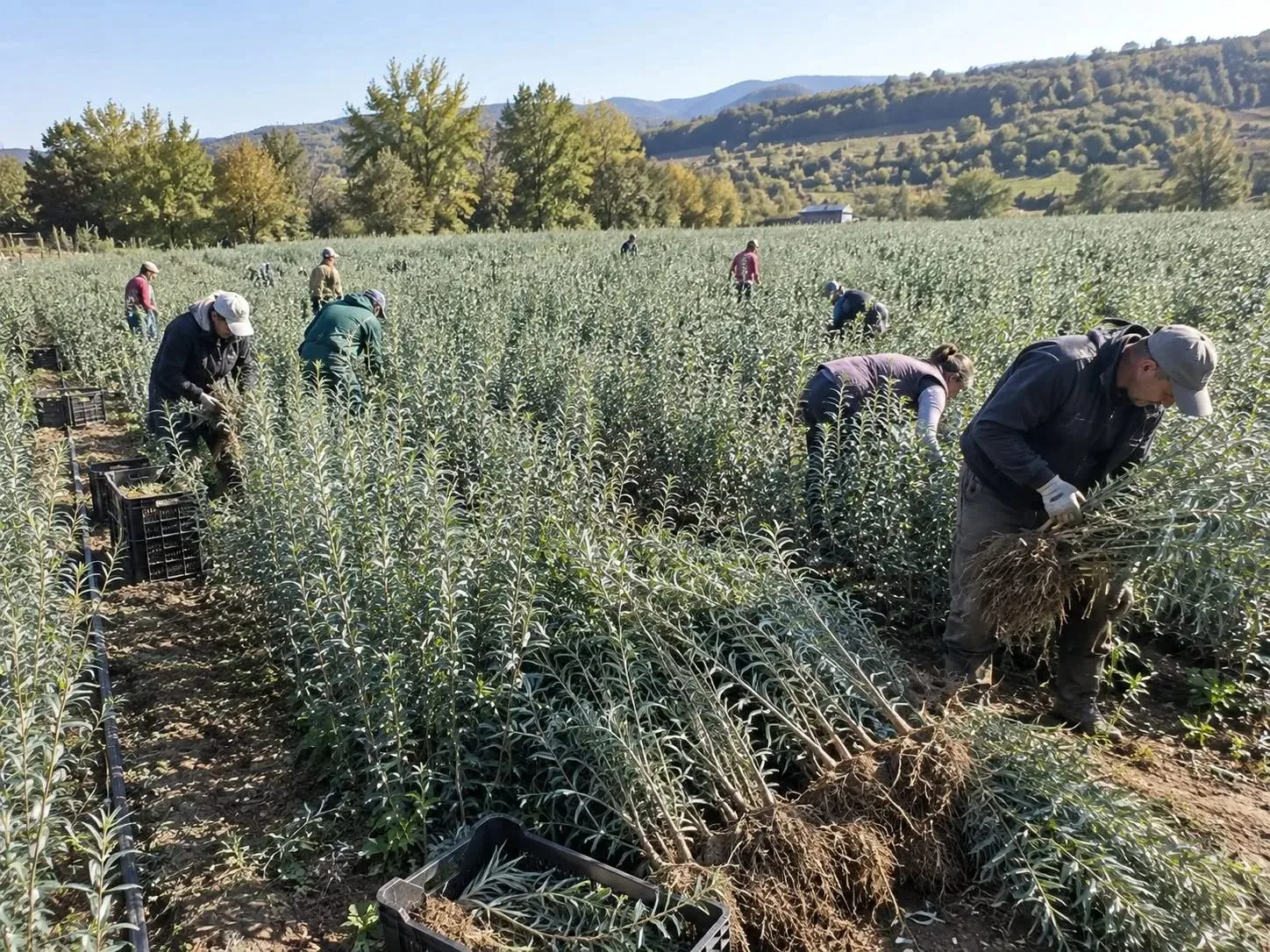
Sea buckthorn harvest is difficult: berries cluster tightly on thorn-bearing shoots and do not readily detach at maturity. The harvest system is therefore an orchard decision as well as a labour choice. Hand picking preserves the standing canopy; branch cutting simplifies separation but removes fruiting wood; machinery can reduce manual handling but must fit the crop and collection route.1
Key takeaways
- Hand picking leaves the plant structure intact but is labour-intensive.
- Cutting fruiting shoots and freezing them shifts work from field picking to cold storage and berry separation.
- Mechanised systems include different approaches; one machine's trial results do not predict performance in another orchard.
- Choose a system after checking layout, regrowth, processing needs and the capacity to handle fruit promptly.
The main approaches differ in what leaves the plant
Hand picking removes berries while branches remain on the shrub. It permits selective collection without routinely removing fruiting shoots. Thorny, tightly clustered fruit makes the work demanding. A 2014 review cites an earlier estimate of about 1,500 labour-hours per hectare for manual harvest. This is historical context from prior literature, not a current European labour budget or a farm-specific prediction.1
Branch cutting, freezing and threshing removes selected fruit-bearing shoots. They are frozen and shaken or rolled so the berries detach. An Ontario government crop profile describes freezing berry-laden branches at about −20°C before rolling off the fruit. The method shifts effort to branch handling, freezing, separation, cleaning and cold storage.2
Mechanised harvesting covers more than one machine type. Research reviews distinguish direct systems that contact fruit from indirect systems that shake plant parts to detach it. Studied concepts include suction, branch or tree vibration, quick-freezing and branch-cutting equipment. Their field and post-harvest demands differ.1
| Approach | Field workflow | Advantage | Constraint to plan for |
|---|---|---|---|
| Hand picking | Pick berries from standing branches | Selective harvest; no routine shoot removal | Labour, thorn access, pace and containers |
| Branch cutting, freezing and threshing | Cut selected fruiting shoots, freeze, then shake or roll berries free | Separates berries away from the thorny canopy | Lost fruiting wood, freezer capacity, branch handling and cleaning |
| Mechanised detachment | Cut, shake or suction fruit into a collection system | Potentially reduces hand contact and increases throughput | Machine fit, access, terrain, crop damage and collection capacity |
Branch cutting moves work from the field to the facility
Treat branch cutting as a planned pruning and harvest regime, not a free shortcut. The Ontario profile notes that berries form on second-year wood and that removing berry-laden branches can reduce the following year's yield. This is a useful regional caution, not a quantified forecast for every cultivar, site or cutting pattern.2 Before adopting it, decide which shoots can be removed, how much productive canopy must remain and how harvest rotations will work.
Map the full workflow: branch collection and transport, freezing capacity, berry separation, debris screening and delivery to the processor. Keep lots identifiable if separate batches matter. If the freezer or transport is a bottleneck, faster cutting may simply move the queue downstream.
Mechanised results depend on machine, date and crop
A branch-shaking experiment shows why trial figures need qualification. In a 2001 study at one Saskatchewan site, researchers tested severed branches from old shrubs of cultivar Indian Summer at different shaking frequencies, amplitudes and harvest dates. The best reported November combination removed 98% of berries within 15 seconds. In January tests, branches became brittle and many broke at the highest tested frequency. These findings describe that cultivar and severed-branch test, not a whole-orchard harvest rate or commercial-machine specification.3
Ask what a proposed system does to fruit and plant. Direct contact may damage berries; shaking may leave fruit behind or stress branches; cutting deliberately removes wood. A machine suited to accessible rows may not fit sloping ground, irregular headlands or a dense canopy. Where possible, test under representative conditions and record removal, fruit condition, debris, plant damage, labour and downstream handling time.
What this means for a commercial orchard
Work backwards from the destination. Confirm whether the receiver needs separated frozen berries, rapid delivery for processing or another specified condition. The limiting resource may be picking labour, machinery, freezing, transport or processor intake. Compare systems on usable crop delivered in the required condition across the full harvest and recovery cycle, not speed at one step. A trial maximum is not a yield, cost or performance guarantee.
Then fit the workflow to the orchard. Machine width, turning space, row length, canopy access and terrain belong in the layout decision, alongside pollination and cultivation. Review the sea-buckthorn orchard-spacing guide before fixing row geometry. Cultivar vigour and relative harvest position shape the operating window; compare Orberry varieties as project options, without assuming cultivar descriptions prove machine compatibility.
Prepare a one-page harvest brief covering target fruit condition, proposed system, labour or machinery access, branch-removal policy, freezing and storage capacity, field access and processor hand-off. Test it against the parcel and processing route before ordering plants or machinery. Orberry's commercial orchard planning can connect harvest choices to orchard geometry. For a next step, plan an orchard around your harvest system.
References
Planning an orchard with these varieties? Adelin answers project questions directly.