
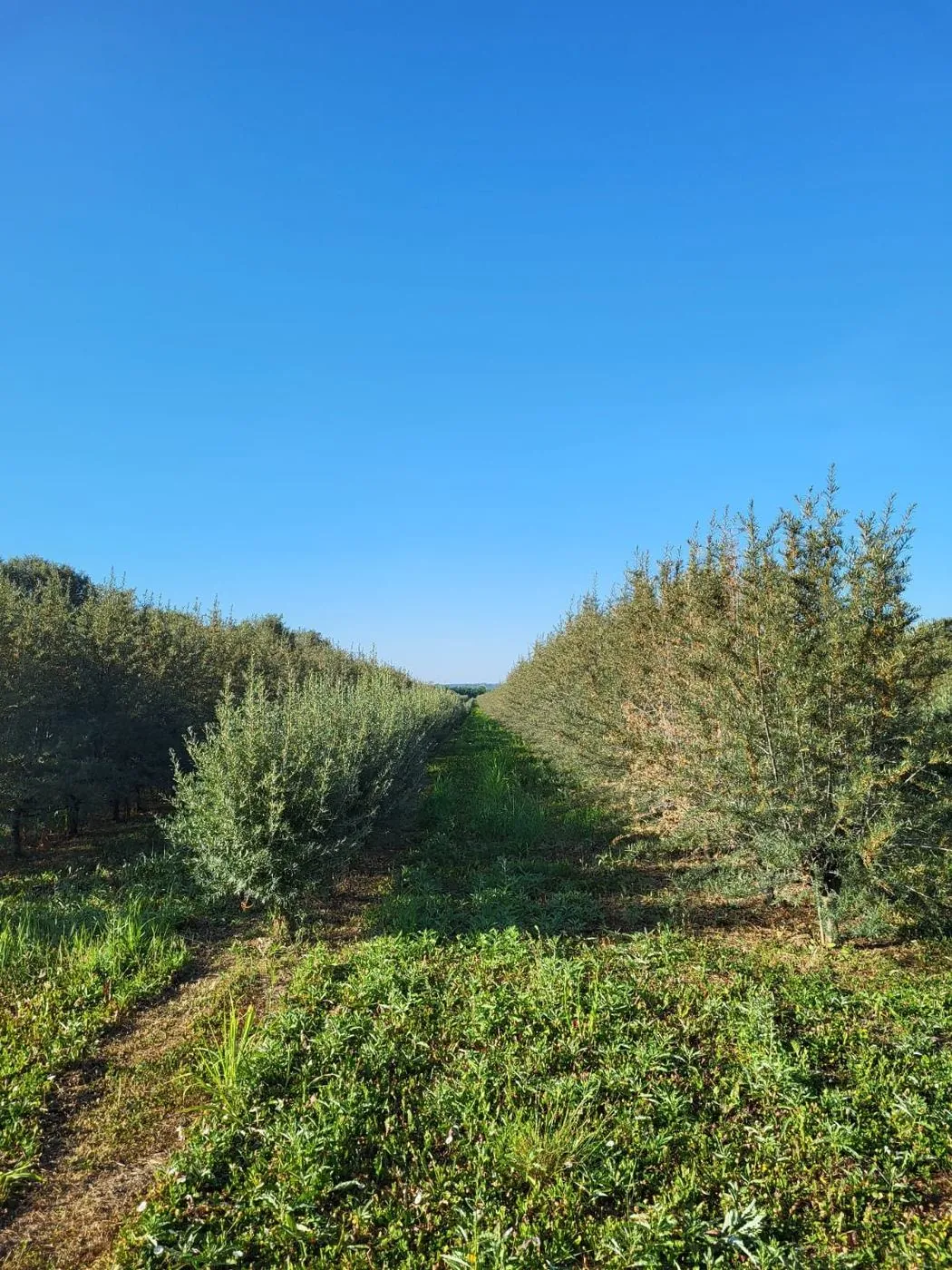
Spacing affects equipment access, canopy room, pollination and harvest. Orberry’s 3.5 m between rows by 1.25 m between plants is a useful calculation scenario, not a universal prescription. Draw the layout around the parcel, machinery and harvest system before ordering.
Key takeaways
- Calculate a first density with 10,000 ÷ (row spacing in metres × in-row spacing in metres).
- At 3.5 m × 1.25 m, the estimate is 2,286 positions per hectare, before allowing for headlands or other non-planted areas.
- Start with machinery and harvest access, then check canopy room, pollinator placement, parcel shape and wind exposure.
- Treat a density calculation as area geometry—not a confirmed order quantity.
Row spacing: begin with equipment and access
Row distance is the interval between planted rows. It must fit equipment used for routine work and harvest, with clearance for safe operation and the developed canopy. Confirm working width and turning needs with operators or machinery suppliers: a tractor may fit where its harvesting attachment or trailer will not.
Published recommendations differ with production setting. Ontario’s government crop guide lists 5–6 m between rows and 1–1.5 m between plants, while an older Canadian production guide gives 4 m by 1 m as an orchard reference and notes narrower rows with pruning in a separate context.1 2 These are useful examples, not competing universal rules. They show why the machinery, training and local operating conditions must be specified before selecting a distance.
In-row spacing and canopy development
In-row spacing affects how quickly adjacent plants occupy the row and how much room remains for access, light and pruning as the orchard matures. Consider the expected growth habit and the way the block will be managed rather than selecting the closest possible interval to maximize the initial count. Review cultivar choice alongside canopy and harvest plans; no fixed cultivar-specific spacing is implied.
Canopy size also depends on site and management. Allow room for inspection and pruning, and do not assume tighter spacing automatically improves commercial performance.
Density: calculate positions, then map the block
Use positions per hectare = 10,000 ÷ (row spacing × in-row spacing), with both distances in metres. For 3.5 m × 1.25 m, 10,000 ÷ 4.375 = 2,285.7, rounded to 2,286 positions/ha. At the same spacing, the calculator’s whole-position estimates are 11,429 over 5 ha and 22,857 over 10 ha.
| Area at 3.5 m × 1.25 m | Estimated positions before headlands |
|---|---|
| 1 ha | 2,286 |
| 5 ha | 11,429 |
| 10 ha | 22,857 |
These are geometric estimates for regular spacing across the stated gross area. They do not subtract headlands, access lanes, buildings, wet or unsuitable ground, awkward boundaries or other unplantable spaces. Nor do they commit a grower to buying that number of plants. Enter a provisional area and spacing in the orchard calculator, then reconcile the result against a field sketch and final row count.
Plan for harvest, headlands and prevailing wind
Sea buckthorn can be difficult and labour-intensive to hand-pick; mechanical harvesters are used in some European systems.1 Decide how fruit will be harvested and transported before fixing row length. Confirm machine width and turning needs with the supplier, then size headlands for the actual tractor, harvester and trailer.
Sea buckthorn is dioecious—male and female flowers occur on separate plants—and wind-pollinated.3 Include the male pollinator in the layout from the start. Consider the site’s prevailing wind and how male positions will distribute pollen through the female rows. A dedicated pollinator row or interspersed males may each be considered depending on geometry and operations; no single arrangement or ratio should be applied without project review. The placement of males matters as well as the plant total.
Ontario’s guide describes north–south rows in its regional guidance.1 Treat orientation as a site decision: compare light, slope, wind, boundaries and access rather than applying one compass direction to every farm.
What this means for a commercial orchard
Draw parcel boundaries, plantable ground, row direction and length, headlands, machinery access and harvest routes to scale. Mark female blocks and male pollinators, then calculate positions for the plantable area rather than gross hectares.
Review the sketch with the cultivar and harvest strategy. See Orberry varieties, commercial orchard planning and professional planting material when specifying variety, age, format and size. Then request a project-specific orchard discussion. Confirm quantities against the field plan, not the calculator alone.
References
Planning an orchard with these varieties? Adelin answers project questions directly.