
THE MALE POLLINATOR
Andros sea buckthorn pollinator
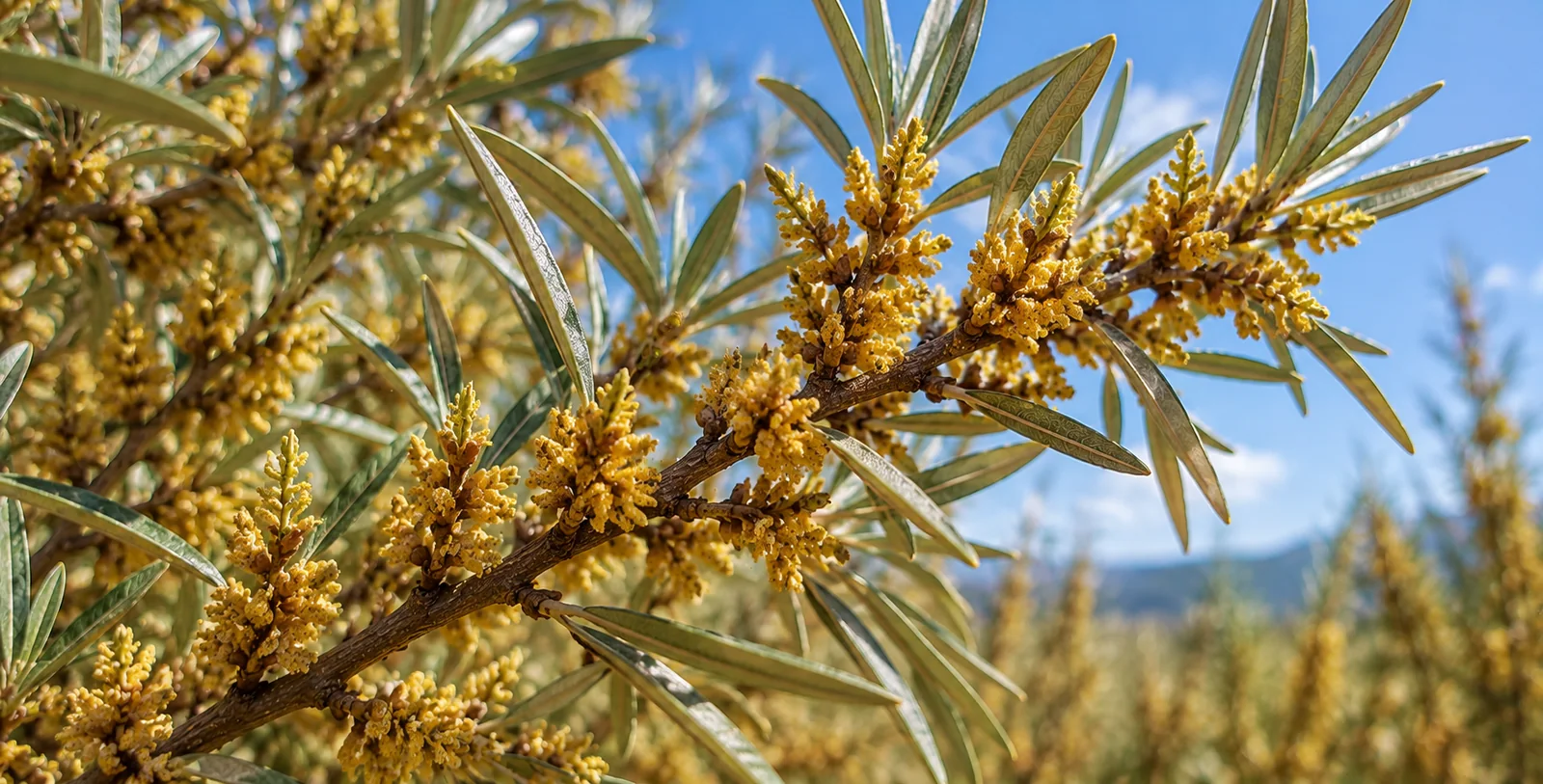
The male pollinator that accompanies Mara, Clara, Cora and Dora. Andros flowers for a long period with abundant, fertile, wind-borne pollen, is compatible with all female sea buckthorn cultivars grown in Romania, and pollinates effectively from year 3 after planting.
AT A GLANCE
Andros at a glance.
Vigour — medium to high · Flowering — mid-season, long-lasting · Pollen — abundant, fertile · Compatibility — all Orberry female cultivars · Fusarium wilt — good resistance
ROLE IN THE ORCHARD
Pollination is an orchard decision.
Andros is the dedicated male pollinator for the four female Orberry cultivars. It supplies pollen rather than fruit and is a central component of the professional orchard system.
FEMALE CULTIVAR
Mara
FEMALE CULTIVAR
Clara
FEMALE CULTIVAR
Cora
FEMALE CULTIVAR
Dora
ORCHARD DESIGN
Pollen where the orchard needs it.
Sea buckthorn is wind-pollinated. The number and placement of Andros plants are defined for each orchard according to the planting scheme, the shape of the plot and the direction of the dominant winds; the planning is part of the Orberry offer.
POLLINATION IN THE ORCHARD
The orchard layout determines the number and placement of Andros plants.
CULTIVAR CHARACTERISTICS
The details that matter.
The Orberry variety profile shows the key botanical, fruit and processing characteristics for professional orchard selection.
| Sex / role | male pollinator |
|---|---|
| Registered | 2010 |
| Vigour | medium to high |
| Growth habit | semi-erect, wide crown |
| Annual growth | 40–60 cm |
| Thorns | moderate, 6–8 cm |
| Flowering time | mid, long-lasting |
| Ripening | Not applicable |
| Harvest window | Not applicable |
| Fruiting onset | effective pollination from year 3 |
| Yield potential | Not applicable |
| Fruit size | Not applicable |
| Average berry mass | Not applicable |
| Fruit length | Not applicable |
| Fruit shape | Not applicable |
| Fruit colour | Not applicable |
| Peduncle | Not applicable |
| Pulp + juice / skin / seeds | Not applicable |
| Total sugar | Not applicable |
| Total acidity (as tartaric, in juice) | Not applicable |
| Ascorbic acid (per 100 g juice) | Not applicable |
| Total oil (fresh fruit) | Not applicable |
| Carotenoids (per 100 g juice) | Not applicable |
| Fusarium wilt | good resistance |
| Suckering | strong, first 4–5 years |
| Crown regrowth after cropping | Not applicable |
| Mechanised harvest | Not applicable |
| Pollinator | Not applicable |
| Processing profile | abundant fertile pollen, compatible with all female cultivars |
| Watch-outs | suckering; lower rooting rate in the nursery |
Juice composition: irrigated culture in Arad, five-year averages; oil is measured in fresh fruit. Yield potential: irrigated mature orchard at 3.5 × 1.25 m; results depend on site, season and management.
Data source: Cultivar characteristics: Pomologia României, Editura Ceres. Figures describe documented observations, not guaranteed results. Pomologia României. Values revised 30 September 2026.
PROFESSIONAL PLANTING MATERIAL
Plan your Andros plant order.
Andros is an Orberry male pollinator. Propagated from the certified mother plantation of the varieties. Commercial planting material is supplied with phytosanitary passport documentation.
SPECIFY YOUR PROJECT
Share your preferred specification and project scale for a current commercial offer.
ORCHARD PROFILE
Semi-erect habit with a wide, balanced crown; annual growth of 40–60 cm, densely set with flower buds. Thorns of 6–8 cm, without consequence since Andros is not harvested. Good resistance to fusarium wilt.
POLLINATION
Sea buckthorn is wind-pollinated. The number and placement of Andros plants are defined for each orchard according to the planting scheme, the shape of the plot and the direction of the dominant winds; the planning is part of the Orberry offer.
WATCH-OUTS
Strong suckering in the first 4–5 years. Lower rooting rate in the nursery, which is why Andros planting material is scarcer and more valuable.
START A COMMERCIAL CONVERSATION
Plan your orchard.
Share your site geometry, female cultivars and plantable area to discuss a suitable pollination arrangement.