
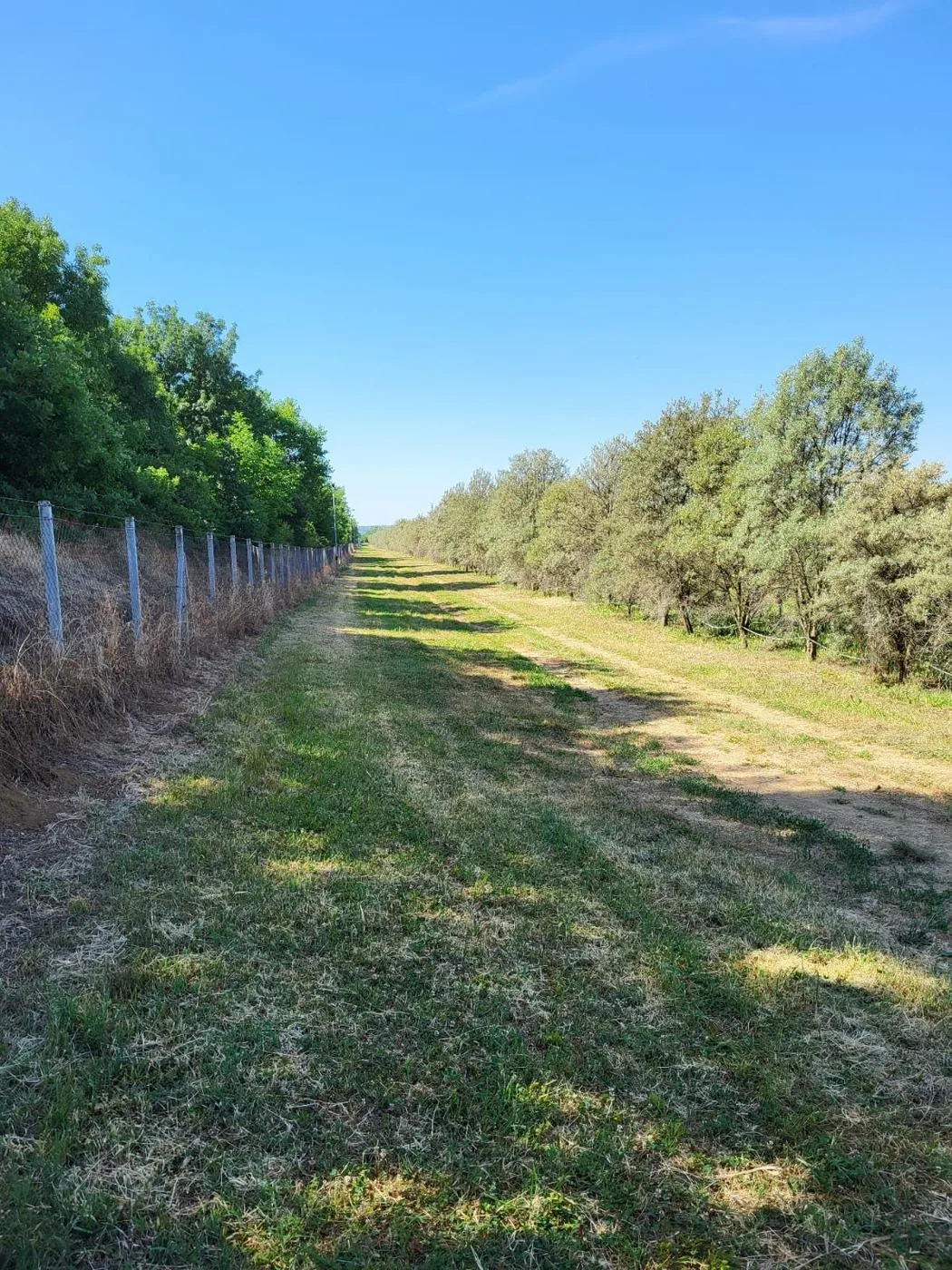
A commercial sea-buckthorn plan needs to account for pollination before rows and plant orders are fixed. The crop is dioecious: female plants carry fruit, while male plants provide pollen. Because pollination is by wind, placing the male component is a design decision—not simply a final percentage added to a female-plant estimate.
Key takeaways
- Andros is Orberry’s dedicated male pollinator for Mara, Clara, Cora and Dora; it produces no fruit.
- Wind direction, block shape and male-plant distribution matter alongside the planned male-to-female count.
- Orberry’s approximate 1:8 starting reference—and broader 1:8 to 1:12 planning range—should inform a layout, not substitute for one.
- Research from a specific Himalayan setting illustrates why proximity matters, but its distances are not a universal European spacing rule.
Why wind pollination changes the layout
Sea buckthorn plants have separate sexes, so fruit-bearing female rows need pollen from male plants. Wind moves the pollen; having a pollinator somewhere on the parcel is not a complete design. A review of sea-buckthorn reproductive biology notes its dioecious, wind-pollinated nature and the importance of male pollen release overlapping female flowering. The review also describes male share in commercial plantings but does not prescribe positions for a particular parcel.1 Choosing compatible cultivar blocks and mapping Andros positions is a separate project-planning decision.
In natural populations in Leh-Ladakh, airborne pollen declined with distance and was detected to 15 m; the authors suggested interplanting males within 10–15 m for effective pollination there.2 These high-altitude, windy Himalayan observations are not from Orberry cultivars in a European commercial orchard. Treat them as evidence that distance is worth checking—not a fixed maximum range, fruit-set threshold or spacing prescription.
Andros is the planned male component
Within the Orberry portfolio, Andros is the dedicated male pollinator used with Mara, Clara, Cora and Dora. It supplies pollen rather than harvestable berries. Orberry’s approved planning reference is approximately one Andros for eight female plants, with a broader indicative range of one to eight through one to twelve depending on orchard design. These are quantity-planning starting points, not a universal biological law or pollination-performance promise.
A percentage can suggest whether a plant list includes a plausible male component; it cannot show whether those plants are usefully distributed. Two layouts with the same count may expose female plants to different pollen paths. Review the Andros profile alongside the selected female varieties.
A practical pollination design check
Use these questions when sketching blocks; check the answers against the actual parcel and production system.
| Design factor | Ask before fixing the plan | Practical planning response |
|---|---|---|
| Prevailing wind | Which direction is common during local flowering, and how variable is it? | Mark likely wind on the field plan; consider windward and internal positions rather than assuming one edge row serves the whole block. |
| Field geometry | How wide and long are female blocks, and where are boundaries or unplantable areas? | Identify distant corners and long female runs; distribute males rather than concentrating them far from part of the block. |
| Row and machine plan | Will male positions interrupt access, turning or harvest workflow? | Integrate pollination points into row planning while preserving headlands, access and machine movement. |
| Flowering overlap | Is local experience or nursery information available on pollen release and female flowering? | Confirm cultivar identity and flowering suitability; assess actual bloom over time rather than relying on a calendar date alone. |
| Quantity | Does the proposed count fit the area and female planting plan? | Use Orberry’s ratio as an initial check, then reconcile it with mapped positions and project requirements. |
This is a planning framework, not an airflow model or guarantee: wind varies within and between seasons.
From ratio to mapped positions
Sketch the female blocks, access routes, headlands, boundaries and unplantable areas; then add proposed Andros positions. Check distribution through or among female blocks and at suitable windward positions, while preserving machinery and harvest flow. A dedicated male row may suit one geometry; interspersed males may suit another. Neither is automatically best.
Calculate initial Andros quantity from the female count, then check the map: a numerically adequate count may still leave part of the orchard poorly served if all males occupy a distant corner. Layout changes also affect plantable positions and order quantities. Use the orchard calculator for an initial scenario, then refine it against surveyed boundaries and machinery requirements.
What this means for a commercial orchard
Before requesting planting material, prepare a plan showing parcel outline, row direction, likely flowering-season wind, female blocks, Andros positions, access and headlands. Record the female-plant estimate and pollinator-count assumptions. This lets you review distribution as well as ratio. For larger sites, consider commercial orchard planning.
Check layout and proposed Andros positions before confirming quantities. Orberry’s orchard planning page supports that next step; final numbers and placement depend on field geometry, local conditions and production system.
References
Planning an orchard with these varieties? Adelin answers project questions directly.