
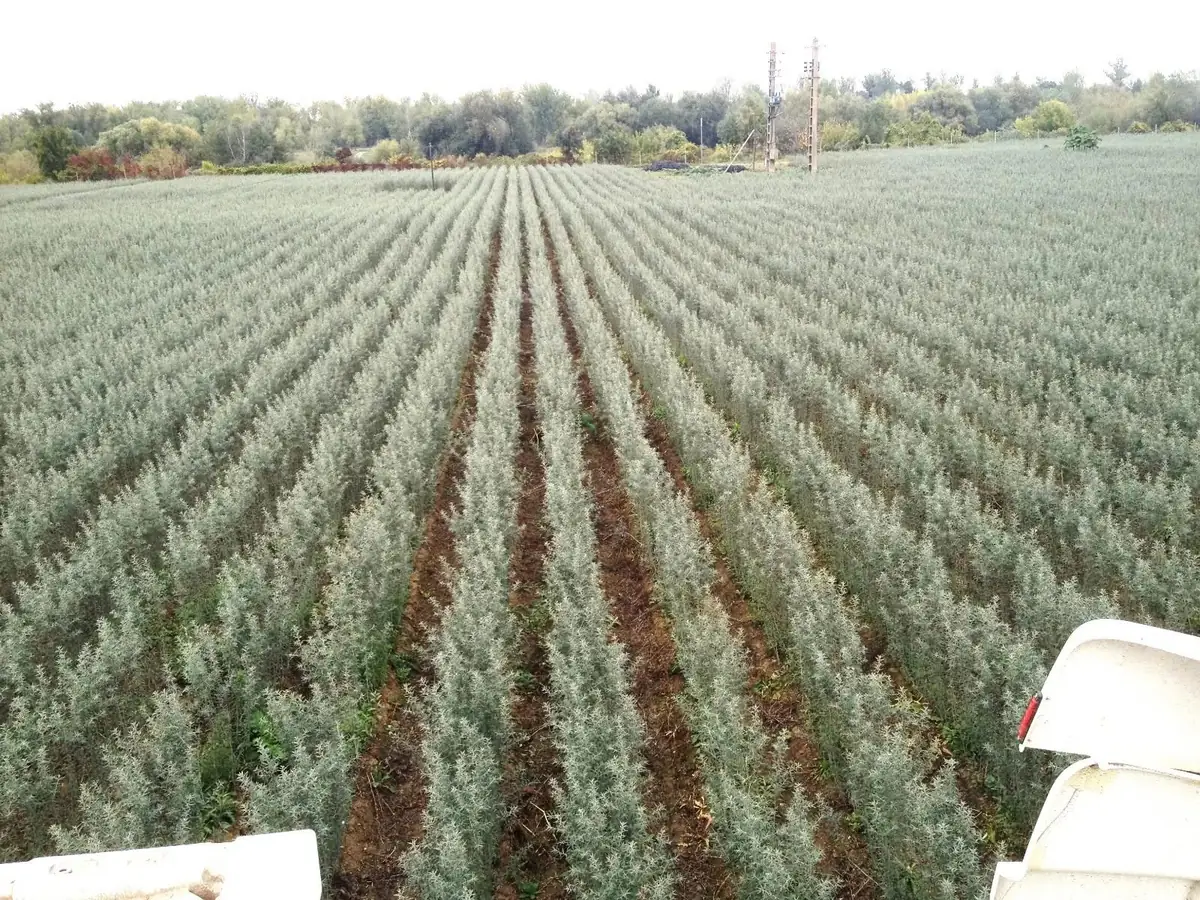
Sea buckthorn is dioecious: male and female flowers are borne on separate plants. Female plants produce the crop, while male plants provide pollen carried by wind. A productive orchard therefore needs both sexes, but choosing a ratio alone does not ensure that pollen reaches flowers throughout the block. The practical plan combines the number of males with flowering overlap, prevailing wind and field geometry.1
Key takeaways
- Male and female sea buckthorn plants are separate; wind transfers pollen from male flowers to female flowers.1
- A male-to-female ratio is a planning reference, not a universal prescription. Published and commercial guidance varies with context.1 2
- Pollinator distribution matters: consider wind direction during flowering, block width, rows, access and machinery—not only the percentage of male plants.2
- Andros is Orberry’s male pollinator for Mara, Clara, Cora and Dora. Confirm its quantity and placement against the actual orchard plan.
What the ratio tells you—and what it does not
A ratio such as 1 male to 8 females describes plant numbers. It does not say where those plants should go or prove that all female rows will receive adequate pollen. Research reviews report that commercial orchards commonly contain a minority of male plants, while recommendations differ by growing context. A University of Nevada Extension fact sheet, for example, advises no more than eight female plants per male and placing males upwind. That is a useful regional reference, not a rule for every European site or orchard design.1 2
Orberry’s cultivar information gives approximately 1 Andros to 8 female plants as an initial planning reference and a broader 1:8 to 1:12 range depending on orchard design. Treat these as starting points for discussion, not a guaranteed pollination outcome or a fixed order specification. The final number should be checked against the site, female cultivars, flowering period and planned layout.
How wind pollination works in the orchard
Male plants release pollen; wind carries it to receptive female flowers. In a commercial block, that means the pollinator needs to be present and flowering at the same time as the females. A review of sea buckthorn reproductive biology notes that pollen-release timing relative to female flowering is an important trait when selecting male plants.1 In the Orberry portfolio, Andros is the dedicated male pollinator for Mara, Clara, Cora and Dora. It produces pollen rather than fruit. Read more about Andros and its role in the Orberry portfolio.
Prevailing wind is one useful design input, not a substitute for distributing pollen sources through a large or irregular block. A windward edge can contribute to pollination, but a design that leaves much of the orchard distant from male plants may not distribute pollen as intended. Depending on geometry, males can be integrated among female rows or placed in dedicated rows. The best choice also needs to preserve machinery movement, headlands and the intended harvest system. The Nevada Extension guidance explicitly puts males upwind; apply that as a contextual layout consideration and review the site’s own wind pattern during the flowering period.2
Plant ratio and placement: a worked estimate
At the Orberry reference spacing of 3.5 m between rows × 1.25 m within rows, geometric positions are estimated as 10,000 ÷ (row spacing × in-row spacing). The results below are rounded position counts before headlands. The final columns show only an illustrative 1:8 male-to-female arithmetic scenario, where the total positions are divided into one male plus eight females.
| Area | Geometric positions before headlands | Illustrative Andros positions at 1:8 | Illustrative female positions |
|---|---|---|---|
| 1 ha | 2,286 | 254 | 2,032 |
| 5 ha | 11,429 | 1,270 | 10,159 |
| 10 ha | 22,857 | 2,540 | 20,317 |
These figures translate spacing and a selected ratio into arithmetic; they are not planting or supply commitments. Real plantable area is reduced or reshaped by headlands, boundaries, access lanes and parcel geometry. Row-by-row placement may also change the total or distribution of each sex. Use the orchard calculator to estimate positions from your dimensions, then review a field layout before fixing quantities.
What this means for a commercial orchard
Plan pollination at the same time as variety, spacing and harvest access. Mark the proposed female rows, note the prevailing wind during flowering, and identify where Andros can be placed without disrupting equipment or picking operations. Then review whether a border placement, distributed plants or dedicated male rows make sense for the block. For larger projects, evaluate row length, headlands, phasing and logistics together through commercial orchard planning.
Keep varietal identity clear when specifying both sexes. Orberry’s professional planting material information distinguishes cultivar, plant age, format and size; project quantities and specifications are agreed for the order rather than assumed from a geometric estimate. See professional planting material and share your location, proposed spacing, female cultivar and field drawing when requesting a project-specific quote.
Your next decision
Before confirming a male-to-female ratio, establish the plantable boundary and row plan, identify the female cultivar or mix, and note the wind direction during flowering. Those details let Orberry assess both the number and placement of Andros for your orchard.
References
Planning an orchard with these varieties? Adelin answers project questions directly.