
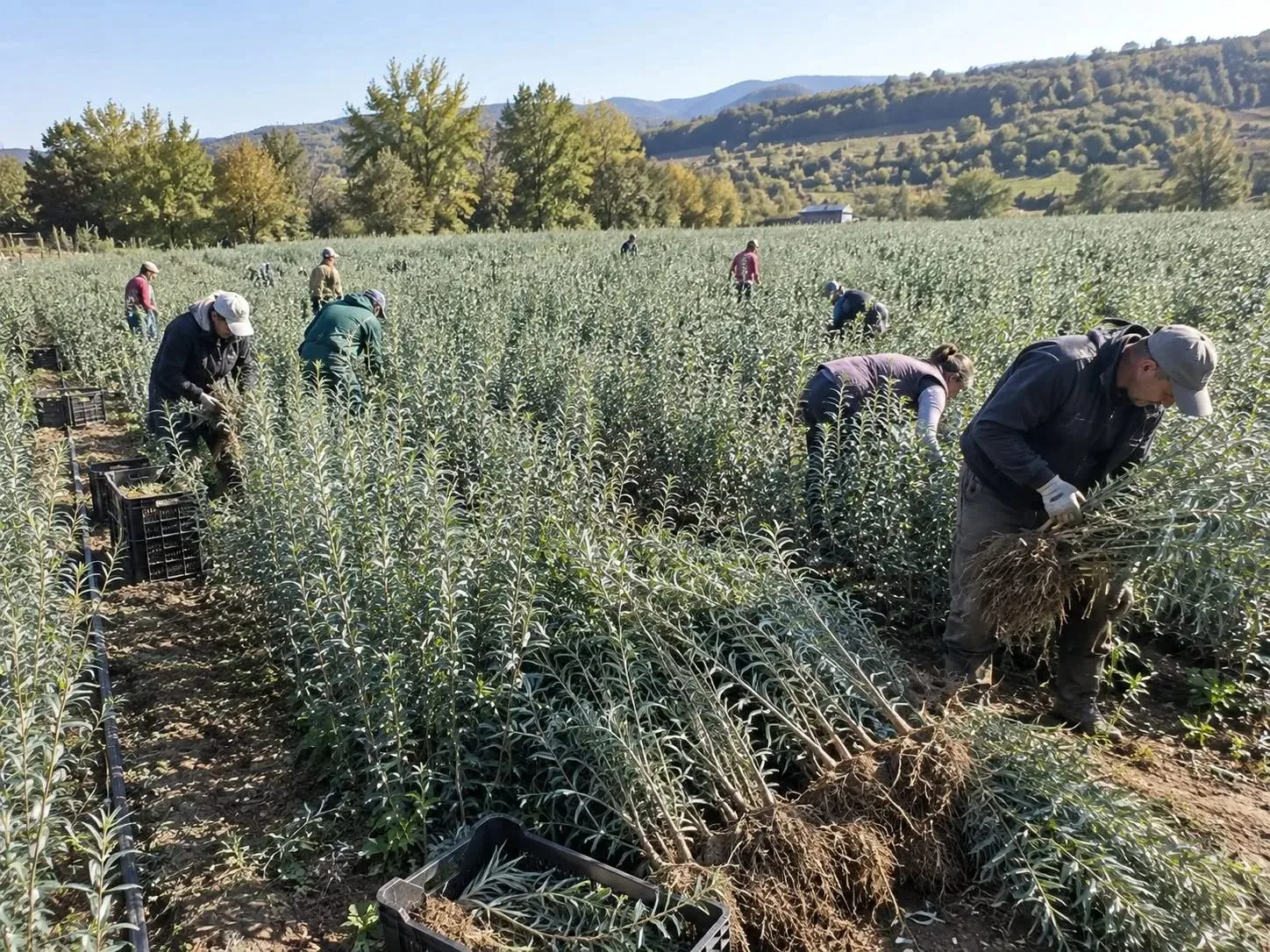
A sea buckthorn orchard can show its first fruit well before it reaches a reliable commercial rhythm. Orberry’s approved cultivar information describes fruiting onset for its female cultivars from approximately the third year, depending on planting material, site and management. This is a planning reference—not a guaranteed date, crop size or income point.
Key takeaways
- Treat first fruit as an early biological milestone, not proof of mature commercial performance.
- Orberry’s around-year-three reference applies conditionally to Mara, Clara, Cora and Dora.
- Published timelines vary with propagation method and production system; regional examples are not forecasts for your farm.
- Build an investment plan around phased establishment and locally tested assumptions, not a fixed yield promise.
The establishment phase comes first
After planting, the priority is to establish a healthy orchard. Site preparation, planting, weed and water management, replacement decisions, labour and machinery access require attention before a crop is available to sell. The timing and scale of these needs depend on the field and local practice.
Plant age and propagation method also affect how published timelines should be read. A 1997 Canadian production guide describes seed-grown plants beginning fruiting four to five years after their first shoots appeared, while plants propagated from cuttings could bear one to two years earlier.1 This older comparison is not an Orberry supply specification, but it shows why a seedling timeline should not be applied directly to named, vegetatively propagated cultivars. Orberry lists Mara, Clara, Cora and Dora as female cultivars with fruiting onset around year three, conditional on material, site and management.
Early fruiting is not mature commercial performance
A few berries show that female plants have begun to fruit. They do not establish the volume, consistency, harvest efficiency or saleable share a business needs. For planning, distinguish establishment, first fruit, increasing production and the production level assumed in a financial model. Test each assumption against evidence from a comparable region, cultivar, planting system and harvest method.
There is no single maturity year that can responsibly be promised for every orchard. The Canadian guide describes peak production at the seventh to eighth year of plant life, but that broad reference is not a prediction for a specific modern cultivar or site.1 A Finnish farm-model analysis treated the first three years as preliminary cultivation years without a proper crop before modelling later production. That is an economic-model assumption, not a biological rule.2 Both examples underline the difference between first fruit and a mature commercial block; neither is a guaranteed cash-flow curve.
| Milestone | What it tells you | What it does not tell you |
|---|---|---|
| Establishment | Plants are developing and the orchard is being managed into production. | That a saleable crop is imminent or all plants will establish identically. |
| First fruit | Some female plants have begun bearing; Orberry’s conditional reference is around year three. | Mature yield, consistent harvests or a financial return. |
| Commercial maturity | Measured block performance can be assessed against a defined business plan. | A universal age, yield or return for other sites. |
Why orchard timelines differ
Planting material and cultivar matter. Plant age is not the same as years since planting, and height alone does not describe age or root condition. Confirm variety, age, format, size and batch documentation. Review the Orberry cultivar profiles and professional planting-material framework before using a timeline in a budget.
Site and management matter. Establishment and growth respond to the conditions in the field. Assess the actual site and plan care with local agronomic advice; a published observation from a different climate cannot substitute for that assessment.
Pollination and layout matter. Sea buckthorn is dioecious and wind-pollinated: female plants bear fruit and male plants supply pollen. A commercial block needs a deliberate pollination plan. Orberry uses Andros with Mara, Clara, Cora and Dora; final placement should account for field geometry and prevailing wind.
Production systems are not interchangeable. A 2025 paper reported second-year commercial fruiting for Augustine and Inia among seven cultivars at 40,000 plants/ha in a high-density meadow-garden trial in the Almaty region of Kazakhstan.3 That result belongs to the studied cultivars and system; it should not be presented as the expected timetable or yield of a conventional orchard. Read unusually early results with their cultivar, density, climate and system attached.
What this means for a commercial orchard
Separate “When might the first berries appear?” from “When can this orchard support the commercial assumptions in my plan?” Record the source and conditions behind each stage assumption. Do not base financing on one trial or the first year in which a few plants fruit.
Your next decision is to prepare a phased plan: confirm the site and processing route, select female cultivars, include Andros, and define planting-material and establishment requirements. Use the Orberry orchard calculator for an initial position estimate and discuss the wider plan through commercial orchard planning. Request a project-specific review and quote after setting out your establishment assumptions; the first-fruit timeline is not a production forecast.
References
- Sea Buckthorn Production Guide
- Koivisto, Economics of Sea Buckthorn Production in Finland, in Producing Sea Buckthorn of High Quality: EuroWorkS2014 Proceedings (Natural Resources and Bioeconomy Studies 31/2015)
- Accelerated Fruiting of Sea Buckthorn (Hippophae rhamnoides L.) Meadow-Gardens in Southeast Kazakhstan
Planning an orchard with these varieties? Adelin answers project questions directly.