
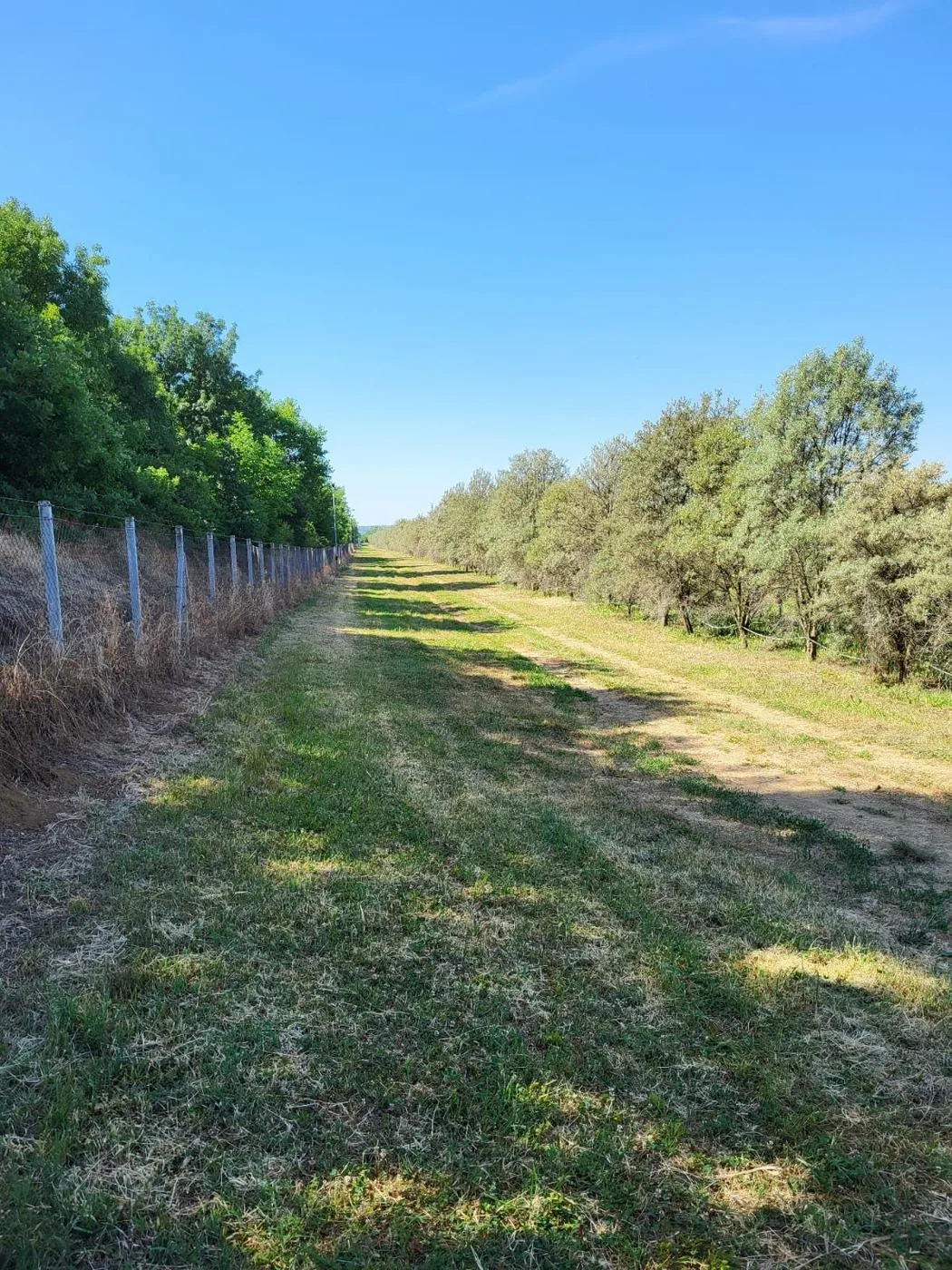
For a first estimate, divide 10,000 square metres by the area allotted to each plant: row spacing multiplied by in-row spacing. At Orberry’s reference spacing of 3.50 m between rows and 1.25 m between plants, that works out to about 2,286 planting positions per hectare before allowing for headlands or other parts of the parcel that cannot be planted. Treat this as a geometry estimate, not a plant-order quantity.
Key takeaways
- Formula: positions per hectare = 10,000 ÷ (row spacing in metres × in-row spacing in metres).
- Reference scenario: 3.50 m × 1.25 m gives 2,286 positions/ha when rounded to the nearest whole position.
- Project totals: at the same spacing, 1 ha is about 2,286 positions; 5 ha about 11,429; and 10 ha about 22,857, before headlands and other unplantable space.
- The final layout depends on plantable area, equipment and access, field shape, harvest system, cultivar and pollinator placement. A calculator result is not a nursery commitment.
Calculate the geometric planting density
First decide which area is actually available for planted rows. Then enter row spacing and in-row spacing in metres. Multiplying those distances gives the nominal ground area assigned to each plant position; dividing 10,000 m² by that area estimates positions within one hectare.
| Area at 3.50 m × 1.25 m | Estimated positions before headlands |
|---|---|
| 1 ha | 2,286 |
| 5 ha | 11,429 |
| 10 ha | 22,857 |
These examples apply the formula to the full stated area and round the resulting project total to a whole position. They are not a fixed Orberry planting package. If an irregular boundary, turning area, access lane, buildings, drainage feature or other exclusion reduces the actual planting footprint, calculate using the net plantable area or refine the row plan. Keep the distinction clear: hectares describe land area; positions describe a theoretical grid; a plant order is agreed separately.
Why spacing changes the answer
Row spacing determines the width of each alley as well as the number of rows that fit across a block. In-row spacing determines the number of positions along those rows. Narrowing either distance increases the mathematical density, but a denser grid is not automatically a better commercial design.
Choose dimensions around the mature orchard system and the way it will be managed. Consider the equipment that must pass between rows and turn at their ends, access for workers and harvest operations, cultivar vigour and the intended canopy. Orchard-planning guidance likewise treats tree arrangement as a decision shaped by goals, tree characteristics, equipment, topography and worker access, rather than a density figure alone.2 3
Sea-buckthorn publications describe several different spacing configurations for different production contexts; shelterbelts, traditional orchard layouts and higher-density concepts are not interchangeable prescriptions.1 2 Use a published distance as context, not as a substitute for designing your block. Orberry’s 3.50 m × 1.25 m spacing is a reference calculation scenario, not a guarantee that every parcel should use that geometry.
Include Andros in the orchard plan
Sea buckthorn is wind-pollinated, so the male component must be included in the layout rather than added as an afterthought.1 Andros is Orberry’s dedicated male pollinator for Mara, Clara, Cora and Dora. Orberry’s initial planning reference is approximately one Andros to eight female plants, with a broader indicative range that may vary with orchard design. Neither number is a universal prescription or a final plant schedule. Row pattern, parcel dimensions and prevailing wind affect where pollinators belong; the number and placement should be set for the project geometry.
The headline density counts planting positions in the grid. It does not decide how those positions are divided between female cultivars and Andros. Do not convert the hectare estimate directly into a female-plant order or assume pollinator positions can be placed arbitrarily. Explore the Orberry varieties and Andros profile as part of that design conversation.
What this means for a commercial orchard
Use the estimate to size the project, compare layouts and begin nursery planning. Before committing to a quantity, map the parcel boundaries and exclusions, confirm row orientation and turning access, and check the proposed spacing against your machinery and harvest approach. For multi-hectare projects, a small change in usable area or layout assumptions can materially change the total number of positions.
The Orchard Calculator can provide a first estimate from area and spacing; its output remains an arithmetic starting point, not an order commitment. Then discuss the female-cultivar mix and Andros placement. When you request a project-specific quotation, provide the net plantable area, proposed spacing, location, planting season and delivery destination. You can also review professional planting material or commercial orchard planning. Plant variety, age, format and size are separate specifications; final quantity, batch details and supply terms should be confirmed for the project rather than inferred from the calculator.
Your next decision
Start with a measured field plan: identify plantable hectares, mark access and turning areas, and choose a provisional row and in-row distance that suit your operation. Run the estimate, then ask Orberry to review the layout and pollination configuration before settling the plant schedule. Calculate my orchard or request a project-specific quote.
References
Planning an orchard with these varieties? Adelin answers project questions directly.