
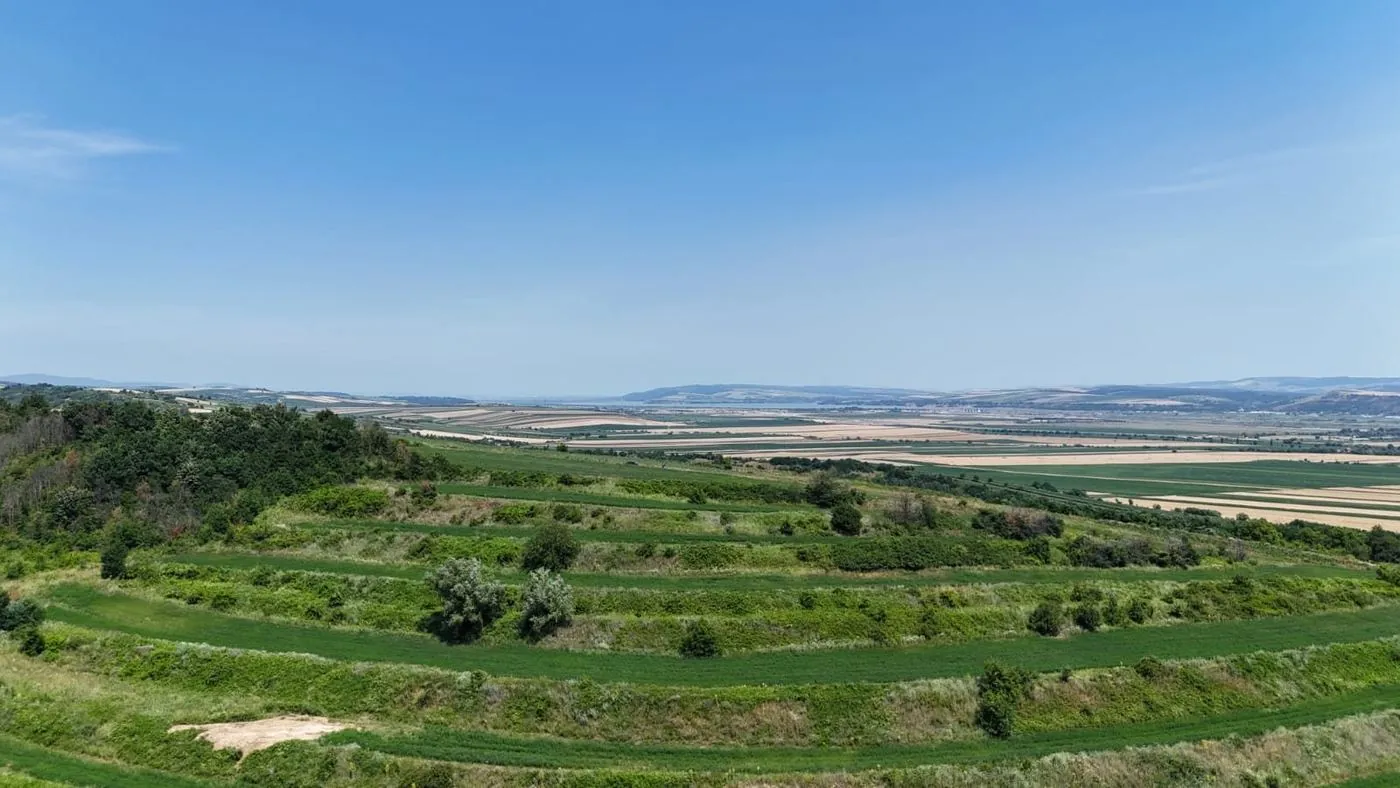
Sunlight, soil, water and climate determine whether a field suits orchard establishment. Assess constraints before choosing cultivars or ordering plants.
Key takeaways
- Prioritize sunny ground and an aerated, free-draining root zone; persistent saturation or a high water table needs investigation.1 2
- Treat pH and texture as screening factors, not pass/fail rules. Published pH guidance varies, so test soil and use local interpretation before amendments.1 2
- Assess both waterlogging risk and access to establishment irrigation; drought tolerance does not remove the need for water planning.2
- Map differences in slope, soil and drainage, and assess distinct zones separately before setting layout or quantities.4 5
Start with sunlight and the local climate
Choose open ground with little shade from buildings, woodland or future rows. A University of Wisconsin–Madison overview lists full sun as preferred exposure and notes that shaded plants may perform poorly.1 Consider how sunlight reaches the proposed rows and whether nearby shelter may cast more shade as it grows.
Do not judge climate suitability from one winter minimum. Sea buckthorn occurs across a broad range of environments, but species-level hardiness does not guarantee performance for every cultivar or site.3 Review local winter extremes, spring frost exposure, rainfall distribution and growing-season length. Map frost-prone hollows and exposed areas, then seek local advice if these create establishment or management risks.
Check soil texture, profile and drainage
Sea buckthorn grows on different soil types, but the production guide emphasizes the root zone’s need for both water and air. It describes deep, well-drained soils as favorable and flags very light sands and dense, water-retentive clays as potential constraints.2 Texture alone is not a verdict: depth, structure, compaction and water movement also matter.
Walk the parcel after substantial rain and note ponding, seepage and areas that stay soft. Inspect representative soil pits for rooting depth, compacted layers, gravel, abrupt texture changes and a shallow water table. The guide warns against high water tables and prolonged inundation.2 Recurrent wet pockets may need a separate layout or specialist drainage assessment.
Interpret pH as a test result, not a universal threshold
pH describes how acidic or alkaline soil is. Guidance differs: the Wisconsin overview gives a general range of 5.5–7.5, while the older production guide calls 5.5–7.0 ideal.1 2 These are reference points, not cultivar-specific targets or guarantees for European soils. Do not lime from a generic online target. Test first, then ask a regional laboratory or agronomist to interpret the result and recommend any correction.
Plan for water, wind and topography
Map irrigation access and reliability through dry periods. The production guide notes that moisture can be important in spring and during establishment, although established plants can tolerate some drought.2 Ensure soil and water can support young plants.
Record prevailing wind, slopes, ridges, low spots, erosion paths and machinery access. Sea buckthorn is wind-pollinated, so wind and orchard geometry belong in layout planning.3 Topography also affects drainage, row orientation and the share of gross area that can actually be planted.
A practical site-screening framework
| Site finding | Initial interpretation | Next step |
|---|---|---|
| Sunny ground, workable soil and no persistent wet areas | Promising starting conditions, not final approval | Test soil zones and plan establishment water |
| Variable texture, shallow or compacted layers, wet pockets, steep sections or uncertain pH | Potentially workable, with variable constraints | Map affected areas; obtain laboratory and local advice before design |
| Repeated prolonged ponding, shallow water table or no reliable establishment-water plan | Significant unresolved risk | Assess drainage and water feasibility before committing to plants |
This is a screening aid, not a formal suitability rating; local climate, soil and orchard operations determine the significance of each finding.
Arrange a basic pre-plant soil assessment
Do not combine visibly different soils, slopes or drainage zones into one sample and assume it represents the parcel. WSU Extension recommends sampling that reflects site variability and notes tests can help detect nutrient availability and physical or chemical limitations.4 Missouri Extension recommends testing at orchard establishment and taking surface and subsoil samples.5 Follow the sampling depths and procedures of your regional laboratory.
Request pH and fertility results, and ask whether texture, organic matter or other analyses suit the site. Include a map of wet areas and soil changes. Use local laboratory recommendations: soil tests inform decisions but do not replace field inspection or justify importing another region’s fertilizer rates.
What this means for a commercial orchard
Prepare a site pack with a parcel map, wet and sloping areas, soil-pit observations, test results, climate notes and water-source details. Estimate genuinely plantable area, not just cadastral area. The Orberry orchard calculator can explore spacing; commercial orchard planning must account for real geometry and operations. A calculated position count is not an order commitment.
Orberry’s female cultivars—Mara, Clara, Cora and Dora—are paired with male pollinator Andros in its portfolio. Site suitability alone does not select a cultivar or determine pollinator placement. Review professional planting material when the site and proposed specification are clearer.
Your next decision
Investigate unresolved drainage, pH or water questions before committing to a planting season or quantity. If basic conditions look promising, share the site map and soil results for a project discussion about layout, cultivar choice and material specification. Request a site-specific discussion.
References
- Seaberry (Sea Buckthorn), University of Wisconsin–Madison Center for Integrated Agricultural Systems
- Sea Buckthorn Production Guide
- The Systematics, Reproductive Biology, Biochemistry, and Breeding of Sea Buckthorn—A Review
- Soil Sampling for Tree Fruit Orchards, Washington State University Extension
- Orchard and Vineyard Soil Testing, University of Missouri Extension
Planning an orchard with these varieties? Adelin answers project questions directly.