
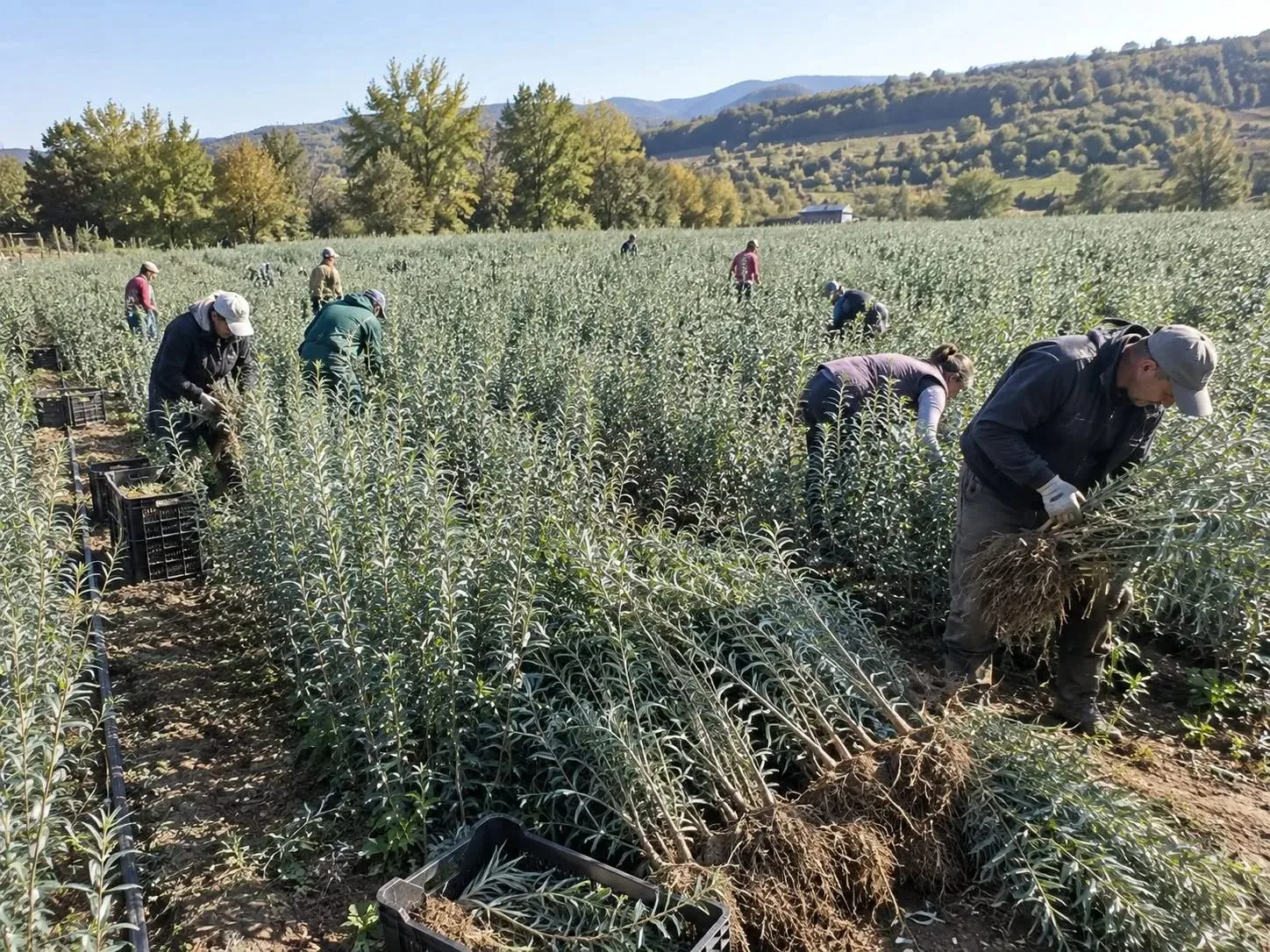
Sea buckthorn fruit is tightly attached and grows on thorny branches, making harvest difficult. Orchard layout shapes access for workers and equipment, the canopy that can be reached, and how quickly fruit leaves the field. Harvesting-machine designs differ, so there is no single layout for every harvest system.1
Key takeaways
- Choose the picking, detachment or branch-removal method before fixing spacing and training plans.
- Design rows and headlands around actual machinery dimensions and turning movements.
- Treat cultivar descriptions as planning clues, not proof of harvester compatibility.
- Map the route from field to cooling, freezing or delivery with the processor.
Choose the harvest pathway first
Manual picking, assisted detachment and branch cutting make different demands on an orchard. A review describes direct fruit-contact machines and indirect methods such as shaking or cutting. A trunk shaker suits some plant forms better than others: a single trunk with short branches transmits vibration differently from long, slender growth. One cutting system moved harvested branches for freezing before berries were separated. These examples illustrate equipment constraints, not a guarantee of suitability for a European orchard or a specific cultivar.1
| Harvest pathway | Design question before planting |
|---|---|
| Hand picking or hand-held assistance | Can workers reach the fruit safely, place containers nearby and carry them out without blocking the next pass? |
| Shaking or in-row machinery | Do alley and headland dimensions fit the machine, and does the plant structure suit its contact and collection method? |
| Branch cutting and separation | Can cut material be staged, loaded and moved to the freezing or separation facility without creating a bottleneck? |
These prompts are not equipment specifications. Manitoba’s regional production guidance describes branch removal as one approach but notes that harvest remains labour-intensive.3 Test the intended operation on representative plants or at a demonstration site before scaling it up.
Fit rows, headlands and access to the machine
Allow room for the planned machine, operator, turning and collection vehicle. Check the complete working envelope, including attachments and clearance from posts, irrigation lines, fences and drains. At row ends, draw the approach, turn and exit. On irregular parcels, plan equipment entry and loaded-fruit removal so traffic does not cross active work.
Montana State University’s orchard-design guide, written for apple orchards, also treats equipment turns, obstacles and row spacing as design decisions. Its crop and regional dimensions should not be transferred to sea buckthorn; the general lesson is to design around the operation planned for the site.2 Validate clearances against the selected harvester’s dimensions and operating guidance before planting.
Orberry’s commercial reference spacing is 3.50 × 1.25 m, or approximately 2,200–2,300 planting positions per hectare before exclusions. This is not a universal layout or a promise of machine clearance. Headlands, soil conditions, mature canopy and equipment affect the workable arrangement. Include Andros, Orberry’s male pollinator, in the geometry review so its placement fits the harvesting runs.
Shape the canopy for access, not just plant density
A dense or spreading canopy can hide fruit and obstruct workers or harvesting heads. Plan training and pruning around the access required by the chosen method, plant habit and production goals. Confirm how equipment interacts with the canopy and what ongoing maintenance it requires rather than assuming one pruning prescription suits every system.
Orberry describes Mara as relatively open, Clara as thick and compact, Cora as erect with a dense structure, and Dora as thick-canopied with medium-to-lower vigour. These traits can prompt questions about reach and row closure; they do not demonstrate machine performance. Cora’s reported fruit firmness and shattering resistance likewise do not prove compatibility with a particular harvester. Compare the Orberry variety portfolio and assess canopy access in the field.
Plan the route from harvested fruit to cooling
Mark where containers, branches or machine hoppers will be emptied, how loads reach a vehicle, and where it can wait without blocking harvest. For fresh fruit, agree handling, cooling and delivery requirements with the buyer. For branch cutting followed by freezing, confirm transport capacity and freezer intake before setting the daily cutting sequence. A historical Canadian guide discusses shade, pre-cooling and cold storage, but its timings and temperatures are older regional recommendations, not a current European protocol.4 Follow the receiving processor’s specifications for the product and equipment.
Connect field operations to the delivery or processing point rather than assuming fruit can wait. Review Orberry’s commercial orchard information and include transport and postharvest routes in the orchard calculator. The calculator is a planning aid, not a substitute for a field layout or machinery review.
What this means for a commercial orchard
Before ordering plants, prepare a harvest brief that records the method; machine or labour route and dimensions; mature canopy access; headlands, turns and collection points; and route to cooling, freezing or delivery. Mark the plan to scale. Walk the proposed route, verify clearances with the machinery supplier and processor, then revise spacing or row orientation where access fails. If mechanisation depends on an unselected or untested machine, record that as an unresolved project risk.
Geometry, cultivar choice and postharvest capacity must work together. Use Orberry’s orchard planning page to prepare a layout for project-specific discussion.
References
Planning an orchard with these varieties? Adelin answers project questions directly.